

You already know what needs to be done. You may even have the skills, the plan, and the confidence to achieve your goal. Yet, somehow, the work keeps getting pushed to tomorrow, then next week, then someday. The strange part is that while you’re waiting, the world isn’t. Opportunities evolve, industries change, and the distance between where you are and where you want to be quietly grows. So why do we keep delaying the very actions that could transform our lives? Let’s explore the psychology behind procrastination, uncover why it happens, and learn practical, science-backed strategies to break the cycle and take consistent action.
What Is Procrastination?
Procrastination is often mistaken for simple laziness, but it is actually a complex psychological battle between your present and future self. It is the act of deliberately delaying a task, despite knowing that avoiding it will lead to negative consequences.
- The Overconfidence Trap: You have the blueprint and the skills. You delay the work because you are completely confident that you can complete it “anytime.”
- Instant Gratification: It is choosing temporary relaxation over the lasting satisfaction of getting things done.
“Procrastination is not a time-management problem; it is an emotion-management problem.”
Why Do We Procrastinate?
Procrastination goes far beyond a simple lack of motivation. It is a complex psychological defense mechanism where the brain actively avoids discomfort.
- Emotional avoidance: Escaping the anxiety, frustration, or boredom a task triggers.
- Overwhelming tasks: Massive goals trigger a freeze response in the brain.
- Lack of clarity: Without a precise roadmap, the brain prefers inaction over ambiguity.
- Decision fatigue: Depleted willpower from making micro-choices makes the path of least resistance irresistible.
- Perfectionism: The demanding standard of flawless execution creates immediate paralysis.
- Fear of failure: Delaying effort protects the ego from realizing your best might not be enough.
- Low confidence: Internal doubt stalls execution, even when you possess the right skills.
- Fear of success: Subconsciously avoiding the new responsibilities and expectations that come with winning.
- Instant gratification: Biology prioritizes immediate comfort over long-term, delayed payoffs.
- Dopamine addiction: The brain craves the frictionless, rapid-fire stimulation of modern distractions over slow, sustained effort.
The True Psychology Behind Procrastination
Procrastination is a complex mental block, not just a simple time-management issue. When you look closely at how the mind works, it becomes clear that delaying work is often a psychological defense mechanism combined with a false sense of security.
Here is the actual psychology behind why we put things off:
Procrastination is a psychological defense mechanism where we avoid the anxiety of a task in favor of instant dopamine, often triggered by the “overconfidence trap”—the false belief that possessing the right skills allows us to delay execution indefinitely. However, this delay creates a dangerous “learning gap“; because industries and methods evolve while you stall, your current knowledge becomes outdated, forcing you to learn new skills just to hit an old target. Ultimately, this arrogant sense of security, combined with the paralyzing overwhelm of perfectionism, tricks your brain into choosing the false safety of inaction over the necessary discomfort of progress.
Signs You are Procrastinating
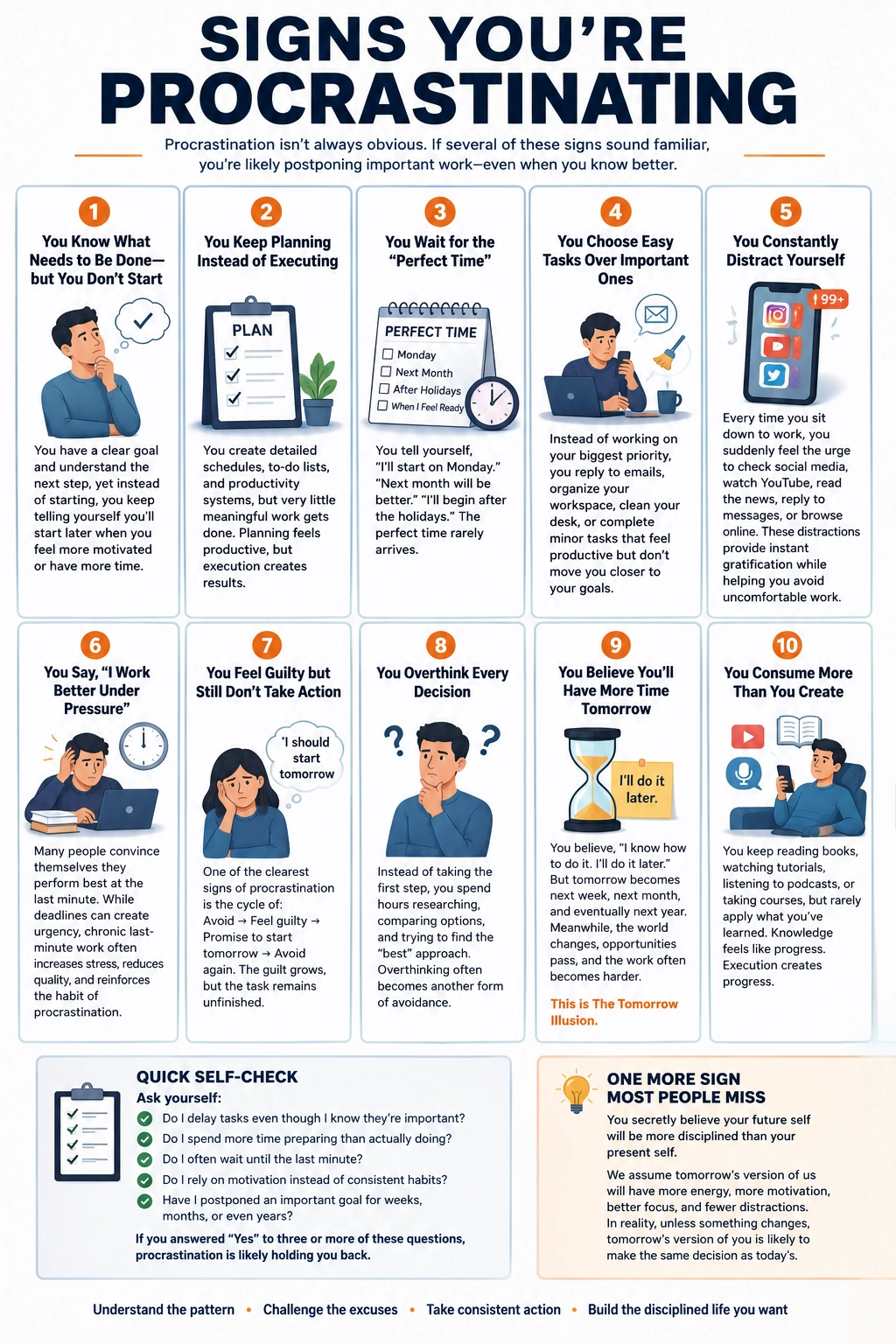
Procrastination doesn’t always look like outright laziness; often, it disguises itself as false productivity and rationalized delays. You might find yourself trapped in a cycle of endless planning without execution, consuming tutorials without actually creating, or prioritizing easy administrative tasks over your most critical, high-friction goals. Common psychological traps include waiting for the elusive “perfect time,” convincing yourself that you work better under the stress of a deadline, or overthinking every minor decision to avoid taking the very first step. Ultimately, if you constantly rely on the illusion that your “tomorrow self” will somehow be more disciplined, while feeling a growing guilt for avoiding the work today, you are actively falling into the procrastination trap.
The Science of Motivation, Dopamine, and Self-Control
Understanding the Neuroscience of Procrastination
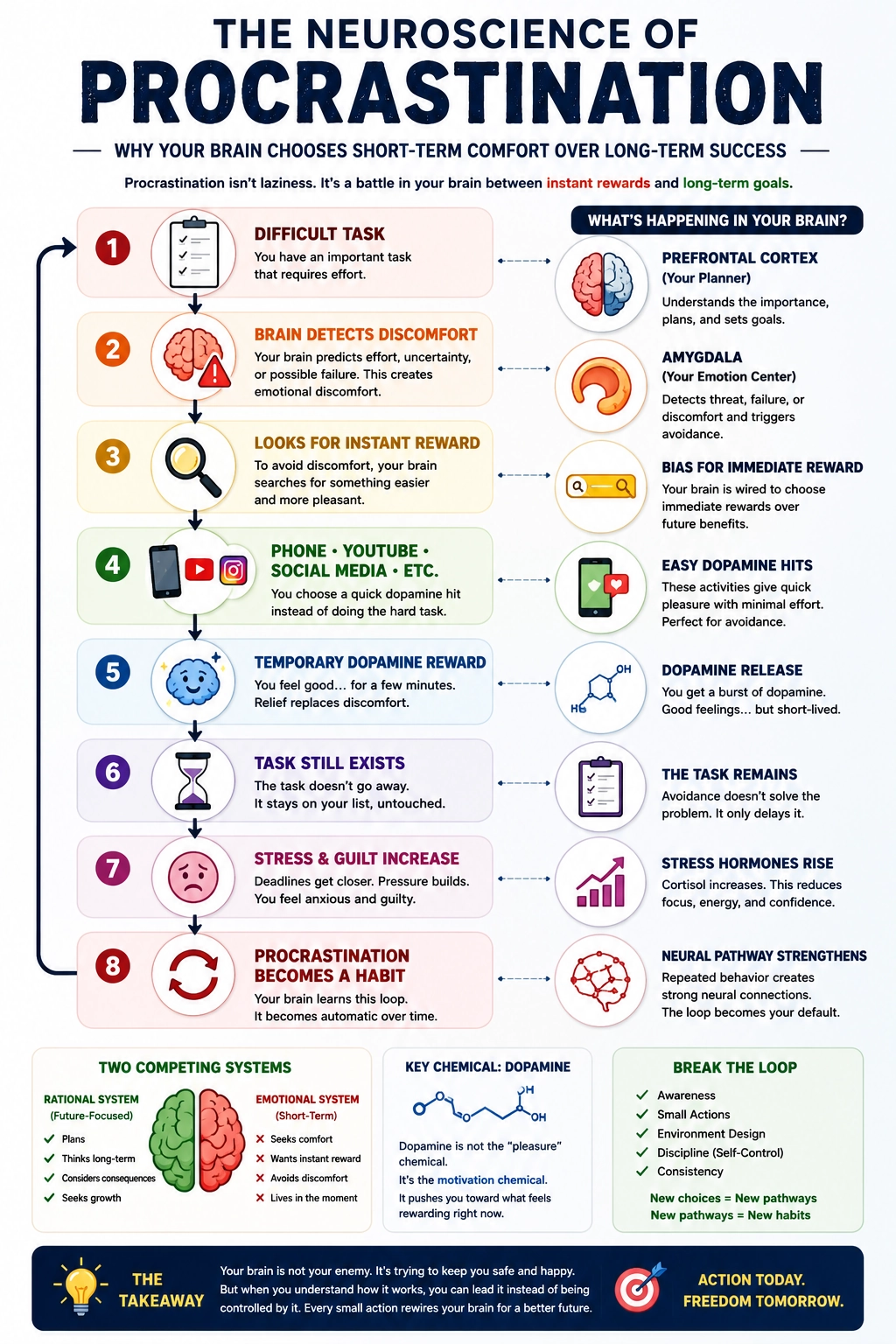
Procrastination doesn’t happen because you’re lazy—it happens because your brain naturally prefers immediate comfort over long-term rewards. When you face a difficult or uncertain task, your emotional brain seeks quick relief through distractions like social media, videos, or other low-effort activities. These distractions provide a temporary dopamine reward, making avoidance feel good in the moment. However, the task remains unfinished, leading to stress, guilt, and an even stronger habit of procrastination. The infographic below illustrates this cycle and explains why consistent action—not waiting for motivation—is the key to breaking it.
Proven Techniques That Actually Work
Understanding the psychology of procrastination is only half the battle. To build a highly profitable digital asset and consistently scale your web properties, you need actionable, daily systems to force execution. Here are the most effective time management and productivity techniques to overcome task paralysis and sustain deep work.
The “Eat the Frog” Framework
Task avoidance thrives on dread. The “Eat the Frog” method forces you to tackle your most difficult, high-friction task first thing in the morning before decision fatigue sets in. By completing the heaviest, most anxiety-inducing task immediately, you eliminate the underlying dread that sabotages the rest of your day, creating a massive psychological win and undeniable momentum.
Time Blocking and Deep Work Windows
High-performance creators do not operate off generic to-do lists; they operate off calendars. Time blocking involves scheduling specific, uninterrupted blocks of time (usually 90 to 120 minutes) dedicated solely to high-ROI output, such as structuring SEO-optimized content or analyzing market data. By allocating a strict time limit, you create artificial urgency and protect your focus from daily digital distractions.
The Pomodoro Technique
For tasks where initiation feels overwhelming, the Pomodoro Technique is the ultimate circuit breaker. Set a timer for 25 minutes of hyper-focused work, followed by a 5-minute break. This technique leverages the psychological urgency of a ticking clock and breaks massive, ambiguous projects into digestible, sprint-like intervals, completely neutralizing the fear of burnout.
Environmental Design (Friction Manipulation)
Your environment dictates your habits. If your phone is on your desk, your brain will inevitably seek the instant gratification of a notification. Design your workspace to increase the friction for bad habits and decrease the friction for good ones. Block distracting websites, put your phone in another room, and keep your primary digital workspace clean and pre-loaded with the exact tools you need for immediate execution.
The Two-Minute Rule
If a task takes less than two minutes to complete, do it immediately. Whether it is replying to a quick partnership email, updating a site plugin, or writing down a single headline idea, executing micro-tasks instantly clears your mental RAM. This prevents small, administrative to-dos from snowballing into a massive, overwhelming backlog.
Your Next 30 Days: From Procrastination to Progress
Reading this article won’t change your life.
Taking action will.
Over the past few minutes, you’ve learned that procrastination isn’t laziness, a lack of intelligence, or a character flaw. It’s often a battle between your brain’s desire for immediate comfort and your long-term goals. The good news is that every small action you take strengthens your ability to choose progress over avoidance.
Now it’s your turn.
Your 30-Day Challenge
For the next 30 days, make one simple promise to yourself:
Every day, complete the one important task you’ve been avoiding before you allow yourself to indulge in distractions.
Don’t aim for perfection.
Aim for consistency.
Week 1: Build the Habit
- Choose one important task each day.
- Work on it for just 5–10 minutes.
- Ignore the outcome—focus only on showing up.
Week 2: Build Momentum
- Increase your focused work to 20–30 minutes.
- Eliminate one major distraction during each work session.
- Celebrate every completed session, no matter how small.
Week 3: Build Discipline
- Schedule your most important task at the same time every day.
- Track your progress using a journal or habit tracker.
- Notice how taking action becomes easier than avoiding it.
Week 4: Become the Person Who Takes Action
- Stop asking, “Do I feel motivated?”
- Start asking, “What’s the next action I can take?”
- Let your identity shift from someone who delays to someone who delivers.
Remember This
- Every masterpiece was once an unfinished idea.
- Every successful business started with a single decision.
- Every fit body began with one workout.
- Every book began with one page.
- Every life changes one decision at a time.
- The opportunity you’ve been waiting for may never arrive.
- The motivation you’re waiting to feel may never come.
- But the next small action is available to you right now.
- The cost of procrastination isn’t just lost time—it’s the life you could have built during that time.
- Don’t let your future become another promise you’ll make tomorrow.
- Start today.
- Start small.
- Start imperfectly.
- But above all…
- START